Legendfantasy Net. Powered by Blogger.

Blogger news

Hi, everyone! Welcome to TOP NEWS!

Pictures from above: the clean-up begins at Bondi after massive Sydney storms

Thursday, April 23, 2015

WENTWORTH COURIER
APRIL 23, 2015 12:38PM

Sand is removed from the area around Bondi Pavillion. Picture: Mark Evans.
Sand is removed from the area around Bondi Pavilion. Picture: Mark Evans
EXCLUSIVE aerial images show the impact of Sydney’s three day storm on Bondi Beach, and the massive clean up that lies ahead for Waverley Council.
The council has begun moving more than 7000 tonnes of sand which was swept off the beach by 155km/h winds from Monday to Wednesday.
Winds swept across Queen Elizabeth Drive, blanketing sand on to familiar landmarks like the pavilion, outdoor gym and skate bowl.
Sand over the car park at Bondi. Picture: Mark Evans.
Sand over the car park at Bondi. Picture: Mark Evans
Helicopter Over Sydney
Sand is removed from the area around Bondi Pavilion. Picture: Mark Evans
Sand over Bondi Skate park. Picture: Mark Evans.
Sand over Bondi Skate park. Picture: Mark Evans
Sand covers the Bondi skate park. Picture: Mark Evans.
Sand covers the Bondi skate park. Picture: Mark Evans
Sand is cleared from Bondi Pavillion after the Sydney Storms. Picture: Mark Evans.
Sand is cleared from Bondi Pavilion after the Sydney Storms. Picture: Mark Evans
These pictures, taken after a day of clean ups, show how much more is still to be done.
Waverley Council workers have used earth moving machinery in a bid to get the sand back where it came from.
With the aid of four bobcats, four excavators and a dozer, a council spokesman said they’re “hoping to reopen the Queen Elizabeth Drive car park and the promenade by Friday afternoon”.
The beach is open today, but lifeguards have warned of dangerous conditions.
Strong winds also damaged the Bronte Beach promenade fence on Tuesday night and it will be repaired in coming weeks.
“Staff are clearing roads and footpaths as a matter of priority to ensure everyone is safe.”

Ceres - A world full of mysteries

Wednesday, April 22, 2015

(Nanowerk News) It was an arrival and a farewell at the same time: On 6 March of this year, when NASA’s Dawn space probe finally arrived at Ceres after a two-and-a-half-year flight through the asteroid belt, the spherical dwarf planet initially disappeared into the darkness. As the space probe was approaching its destination from the dark side, the onboard scientific camera system was unable to take any new pictures. For five long weeks. Now, Ceres has come into view again. Photos from mid-April afford a first glimpse of the north pole of the dwarf planet.


Slim crescent: the first image of Ceres after arrival of space probe Dawn, captured on April 10, 2015. (Image: NASA/JPL-Caltech/UCLA/MPS/DLR/IDA)
The mission being undertaken by Dawn - the American space probe launched on 27 September 2007 - is now entering its crucial phase. One of the most pressing issues, which is also of strong interest to the participating researchers from the Max Planck Institute for Solar System Research in Göttingen, concerns the ice on Ceres. Is there a layer of frozen water below the dark grey surface of the dwarf planet? Does the largest body in the asteroid belt perhaps even eject water vapour into space? Over the coming weeks, Dawn could provide a crucial piece of the jigsaw for our understanding of how water is distributed in the solar system.
The most recent images of Ceres show only a small detail of the surface, since large regions of the northern hemisphere are in the shadows. However, similar to the images from the approach phase at the beginning of the year, they reveal a world full of mysteries. Like most residents of the asteroid belt, Ceres is covered with craters – records of its continual bombardment by smaller rocks.
But no two craters are the same. Their exact form allows geoscientists to draw conclusions about the material make-up of the surface layers. “Conspicuously large numbers of craters on Ceres have prominent mountains in the centre,” says Andreas Nathues, who heads the Dawn team at the Max Planck Institute for Solar System Research, which is working on evaluating the camera data.
Similar structures are known from craters on Earth, the Moon and Saturn’s moon Mimas as well; however, on these bodies they do not occur as frequently with craters that are already medium sized. According to initial evaluations, many Ceres craters tend to be shallower as well.
All these could be crucial indications, as all measurements and evaluations are dominated by one question: Does ice exist on Ceres? Do the crater structures indicate a transient substratum with a high degree of plasticity?
The investigations of the overall density of the dwarf planet in particular have been spurring on Ceres research for many years, as the rock, measuring some 950 kilometres across, turns out to be much less dense than, for instance, the terrestrial planets of the inner solar system. Subterranean water – whether frozen or liquid – could lead to these measured values.
The next surprise followed at the beginning of 2014: The Herschel space observatory sporadically observed water in the environs of the dwarf planet. Does the water evaporate into space from Ceres’ surface? Or might it even be a sign of cryovolcanism? In the outer solar system, this form of volcanism occurs in the icy moons of the planets Jupiter and Saturn, for example. Instead of the hot lava produced in terrestrial volcanism, other fluids, such as water, gush up from the interior of these celestial bodies.


View of the North Pole: at the top of this image of Ceres, the bright spots are visible which could already be seen when Dawn was approaching the dwarf planet. This picture was taken on April 15 from a distance of 22,000 kilometres. (Image: NASA/JPL-Caltech/UCLA/MPS/DLR/IDA)
Ceres, in any case, appears to be an unusual world. Many researchers think that the spherical rock is the link between the rocky bodies of the inner solar system and the water-rich dwarf planets and moons further out. Ceres could help us to understand how the planetary system was split into two at its formation – and where precisely the boundary between the two regions lies.
It is thus no wonder that it has not only been scientists who have been looking with interest at scattered bright spots on Ceres’ surface in recent months. The first indications of these surface structures were already visible in January 2015 from a distance of more than 230,000 kilometres.
“The spots reflect at least 40 percent of the incident light and occur, as can meanwhile be seen, almost exclusively in combination with craters,” says Andreas Nathues. It is hoped that images and spectra with better resolution obtained over the coming weeks and months will help the scientists clarify whether impacts here exposed subterranean, hidden ice.
Dawn is equipped with three measuring instruments for its scientific mission. While GraND – a detector for gamma rays and neutrons – is to track down a number of elements such as magnesium, silicon, oxygen and iron, the VIR spectrometer will investigate the visible and infrared electromagnetic radiation that Ceres reflects into space. This will then provide information about the mineralogical composition and temperature of the surface.
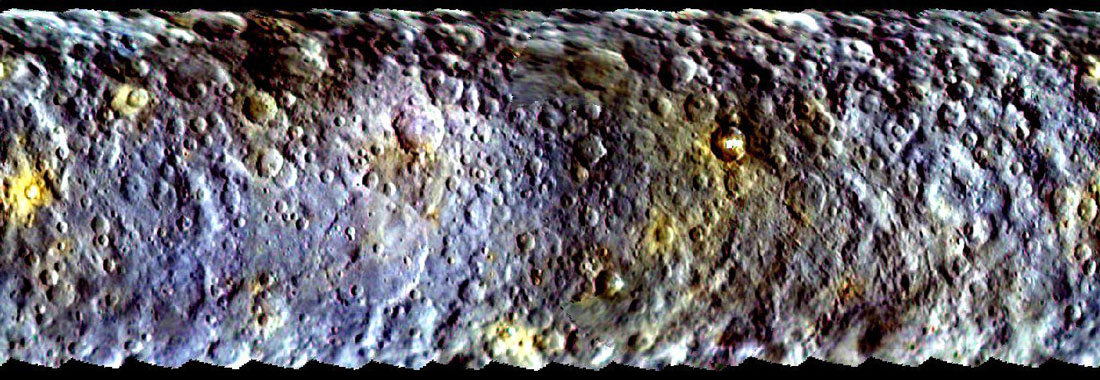
The scientific camera system is responsible for the continuous photo shooting, which should provide tens of thousands of images by mission’s end. The system was developed and built by researchers at the Max Planck Institute in Göttingen. And the data it supplies can be used not only to construct terrain models and topographic maps: Equipped with seven colour filters, the camera system can also filter out several wavelength ranges of the reflected visible light. These ranges contain the characteristic fingerprints of certain minerals and thus enable conclusions to be drawn about the composition of the surface.
“The topographies on Ceres are more varied than is obvious to the naked eye,” adds Andreas Nathues. The first maps of the spectral distribution show clear variations. During the next few weeks, the Max Planck researchers want to study them more closely in order to understand which minerals are present there. The scientists will receive data with a better resolution at the end of May. At that time, Dawn will be only 13,500 kilometres away from Ceres. The separation will then decrease to a mere 370 kilometres over the course of the mission.
For the researchers, this is an exciting time – but nothing really new. They have already experienced an approach phase, once before cautiously coming closer and closer to a still unknown heavenly body, feverishly awaiting every new image. In July 2011, Dawn reached its initial destination: the giant asteroid Vesta, only 60 million kilometres closer than Ceres to the Sun, which it orbits in the asteroid belt. The scout found a rocky world with an extremely varied geology: huge basins, parallel grooves and the highest mountain in the solar system, towering to a height of more than 22 kilometres.


Colourful dwarf: The colour filters in Dawn’s camera system help to reveal differences in the composition of Ceres’ surface. In this mosaic, they are depicted in false colours. (Image: NASA/JPL-Caltech/UCLA/MPS/DLR/IDA) (click on image to enlarge)
Dawn is thus the first mission in the history of space travel to swing into orbit around two extraterrestrial bodies, one after the other. This is possible not least thank to its propulsion technology. In contrast to most space probes, Dawn is equipped not only with chemical rocket engines, but also utilises ion propulsion.
Xenon atoms are first ionised in a magnetic field, accelerated and then ejected. Similar to a jellyfish, which releases water by contracting its bell, ion propulsion generates a recoil – which accelerates the space probe.
To this effect, the ion propulsion can easily be operated over weeks and months, and the space probe accelerated gradually to high speeds. This is the only way a demanding flight route, such as Dawn’s to two bodies separated by a considerable distance, is even possible – and affordable.
However, Dawn is also pioneering in another respect: it is the first time a space probe will accompany a dwarf planet for a longer period. This is scientifically very valuable: “This class of celestial body can reveal a great deal about the formation and evolution of the solar system,” says Nathues. Dwarf planets are a type of hybrid: too small to be a planet, yet already round and significantly larger than the irregularly shaped asteroids. Researchers believe that an early phase of planetary formation is preserved in them.
This makes it all the more exciting that Dawn’s stopover at Ceres coincides with the climax of a further space mission: Next July, NASA’s New Horizons probe will fly past the dwarf planet Pluto at a distance of only 9,600 kilometres and, for the first time, study the body at the outer edge of our solar system close up. Yet another dwarf that could change our understanding of our cosmic home.

UFO caught on video over Rome by professional photographer


A professional photographer was filming an airliner from the patio of his home on the outskirts of Rome when he caught something on video he cannot explain. He did not see the object as he was filming, but upon review of the footage, a strange object can be seen for a couple of seconds. Local UFO researchers are just as baffled as the witness.

This UFO sighting has been covered in Italian news, and was investigated by the Mediterranean UFO Center (C.UFO.M). The name of the witness has been withheld.

According to C.UFO.M, the unnamed witness is a professional photographer who specializes in taking photographs of actors, singers, and other important people. On April 12, 2015, at his home on the outskirts of Rome, the photographer was filming an airliner using his Panasonic Lumix camera with a 60x zoom lens.

Upon review of the video, the photographer noticed a strange object pop onto the screen for a short period of time.

C.UFO.M examined the video to help determine what the object is. In their analysis, posted on their website, the investigator, Angelo Maggioni, first determined that the object was not a bird. He says the object is too high, and that the UFO does not look like other birds that have been captured in images.


UFO and birds comparison. The UFO videoed in Rome is on the bottom right. (Credit: C.UFO.M)

Maggioni also ruled out a balloon. Again, he felt the object was too high, and he notes that the object appears to have moving lights on it. He notes that there could be some reflections, but that the sun is to the left and not all of the reflections appear to be to the left.


A balloon image added to the analysis by C.UFO.M. Researcher Maggioni notes that a balloon can easily be identified in high quality images. (Credit: C.UFO.M)

In the end, Maggioni has no explanation. He feels it is a self luminescent object that, to him, remains a UFO.

Maggioni calculated the height of the object by concluding that the UFO was in focus and so it must be about the same distance as the airliner. He estimates it is 13,000 meters, or over 40,000 feet high. That would be around the same altitude as the airliner. Although, the still images look fuzzy and out of focus to me.


Close-up of the UFO caught on video in Rome. (Credit: C.UFO.M)

Also, as the camera pans to keep track of the airliner, the UFO flashes by. This could be because the UFO is stationary, or moving slowly, and much lower than the airliner.

As for the UFO’s lights, if the object is an odd-shaped, or misshapen, silver balloon that is spinning, reflections would change rapidly and look to be in odd places. When C.UFO.M zooms in on the object in their video (seen at the top of this story), the object does look disc-shaped. And we all know what is disc-shaped, that’s right, a balloon. Oh yeah, UFOs too.

The object is so small and far away that even though the photographer used a good camera and zoom lens, it is hard to know exactly what he caught on camera. Is this some sort of craft with lights on it, a mere balloon, or do you have another theory? Let us know below.

Search


Search This Blog

News Category

Popular Posts